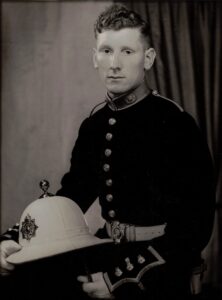
We’ve come to know Ray Morrison and his wife Sharon over the last couple of years, since they moved from Hamilton to Deep River and joined St Barnabas Anglican Church. Amongst other things, Ray had worked as an insurance adjuster and was chairman of the Canadian Equestrian Team. While visiting us for tea one day, Ray told me he had seen enough of nuclear technology for a lifetime, and told me his fascinating story of Operation Hurricane.
Ray was born in London, England, growing up during WWII (including evacuation to a farm in Yorkshire). Following the war, Ray joined the Royal Marines for two years of national service – his years in the Scouts served him well when he trained as a commando. He later learned to be an engine room operator and mechanic for landing craft; this new skill meant that he and some companions were “volunteered” for a secret mission, sailing with a small Royal Navy fleet to the Montebello Islands off the northwest coast of Australia. This wasn’t a jaunt to wave the royal ensign and enjoy the warmth of the Antipodes, but rather a mission to test Britain’s first atomic bomb – Operation Hurricane on 1952 October 3.
The Society for the Preservation of Canada’s Nuclear Heritage (aka Canadian Nuclear Heritage Museum) interviewed Ray, and recently released it as part of our collection of 21 videos (nuclearheritage.com/interviews). But how does Ray’s story fit with Canada’s nuclear story?
During WWII radar research was preeminent in Britain, to protect the life-saving Atlantic convoys being attacked by U-boats. People like W.B. Lewis, post-war scientific director of the Chalk River laboratories, worked on radar, but nuclear research was deemed very important in the longer term. The British nuclear project was driven by the British fear that Germany would build a nuclear weapon first, and use it; unbeknown until the end of the war, UK nuclear research led the world until mid-1942, when it was superseded by the USA. The UK shared all its radar and nuclear knowledge (and also penicillin) with the United States, in the hope that America would apply its vast resources to further research and industrialization in these fields. In 1942 August it was decided to move much of the UK nuclear weapons program, code-named Tube Alloys, to Canada; not only was Canada safe from bombs, but it was close to the USA and their weapons program (the Manhattan Engineer District, aka Manhattan Project). A number of Cambridge University nuclear researchers moved to Montreal in 1942-43, where they were joined by Canadian scientists and engineers. The Montreal Laboratory, and its successor Chalk River Nuclear Laboratories, were under the jurisdiction of the National Research Council of Canada. The USA military-run Manhattan Project was often at odds with the civilian UK-Canadian program, over fears of espionage and post-war applications. Cooperation was therefore limited, although in 1944 the Americans requested that Canada build a heavy-water-moderated reactor for irradiating uranium and producing plutonium for USA weapons. The outcome was the NRX reactor – designed in Montreal, built and operated at Chalk River from 1947 to 1993.
Following the end of WWII, Canada decided not to pursue nuclear weapons technology, although it sold irradiated fuel from NRX to the Americans, from which plutonium was extracted. Most British scientists, including Chalk River director John Cockcroft, returned to the UK after WWII to establish their own weapons program, since the USA did not share its nuclear technology.
The British nuclear program focused upon producing plutonium and weapons, spurred on further after the first Soviet atomic weapon test on 1949 August 29. The British – a sea-going nation – feared a nuclear bomb might be placed on board a ship and detonated in a port. As the British nuclear program advanced with reactors, plutonium processing and designing an atomic bomb, they needed a location to test their new weapon. Aside from proof of concept and detonating a bomb in a ship, a test explosion would demonstrate to the world (especially the USA and USSR) that Britain was still a major player.
There was nowhere in the crowded British Isles to perform a test, and the predominant westerly winds precluded a test that could blow radioactive fallout over densely-populated Europe. The USA was asked if the British tests could take place in the Nevada testing grounds, but there were difficulties – the British feared their weapon might fail in front of the Americans, and also wanted their first test to simulate a weapon detonated in a port. Thus the UK turned to two friendly countries with large expanses with few inhabitants. Australia had the uninhabited Montebello Islands off the northwest coast. Canada had large expanses of relatively unpopulated tundra, and several sites were investigated: Belcher Islands, Arviat, Frobisher Bay and Coral Harbour (Nunavut); Port Nelson (Manitoba); Suffield (Alberta). The final choice was Churchill (Manitoba); according to the 1950 report Technical Feasibility of Establishing an Atomic-Weapons Proving Ground in the Churchill Area, the land near Churchill was a “wasteland suitable only for hunting and trapping.” Up to 12 explosions were proposed for the Churchill area.
Thankfully for Canada, the Churchill site was too shallow and the British preferred Australia’s warmer climate – both physically and politically. Apparently Australian Prime Minister Robert Menzies approved the British tests without even consulting his cabinet, while there is no evidence the Churchill proposal even reached the office of Canadian Prime Minister Louis St Laurent.
Beginning with Operation Hurricane, which Ray Morrison observed at an uncomfortably-close distance (watch his fascinating interview), three tests were done in the Montebello Islands with a further nine tests in the interior, all leaving a radioactive legacy. I am thankful Canada escaped this aspect of nuclear science and technology.