The late 1970s saw an optimistic future for the world economies. However, the OECD (Organization for Economic Co-operation and Development) cast a shadow with its forecast of a peak in world oil production by the mid-1990s.
Nuclear-generated electricity then appeared to be the only energy source available to meet the world’s increasing energy needs. There was a concern, however, regarding the availability of sufficient fissionable material.
Within AECL, W.B. Lewis had long been championing the concept of “electronuclear breeding” where fissionable material such as 233 U can be produced by surrounding a proton-beam based, intense neutron source with a blanket of 233 Th, which after neutron capture, decays to 233 U. (A single 1-GeV proton hitting a heavy-element target made of liquid lead or bismuth releases 30 to 40 neutrons by the so-called “spallation” process.)
No existing accelerator in the world came within two orders of magnitude of the beam power needed to make electronuclear breeding economically feasible. To test the designs needed for a powerful, high-energy device, a 1% energy (10 MeV), prototype project, called ZEBRA (Zero Energy BReeder Accelerator), was launched in 1981. This accelerator was designed to produce a 300 mA, 10 MeV proton beam (3 MW) to test design concepts.
Federal politics entered the scene shortly after this point. The Federal Government decided that AECL should increase its presence in the province of Quebec and that the ZEBRA project would best be located near Varennes where a large fusion project (Tokamak de Varennes) was also just getting underway. As a result, a large portion of the design team at Chalk River divided their time between accelerator design and French-language training.
Over the next five years, the situation was to change. The slowdown in new nuclear installations in the world coupled with the discovery of large deposits of high-quality uranium ore in Saskatchewan and Australia were one factor while another was the changes in portfolios of influential Cabinet Ministers in the Federal government. These changes resulted in a decreased emphasis on AECL’s presence in Quebec. As a result, the ZEBRA program was terminated in 1985, although testing of equipment already assembled continued for several more years.
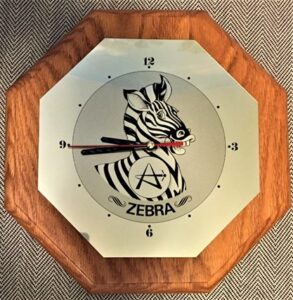
Because the ZEBRA program was terminated before significant progress was made, the Canadian Nuclear Heritage Museum can offer visitors only design documents. We do nevertheless have a retirement-gift clock with the ZEBRA logo. To arrange a tour please contact us at info@nuclearheritage.com