
The startup of the Nuclear Power Demonstration (NPD) reactor at Rolphton in 1962 was quickly followed by the establishment of a training center for a wide range of professions and trades that would be needed to operate future Canadian nuclear power stations.
Started in 1963, the training center first operated in a converted construction warehouse near the NPD reactor. In 1965 a new, dedicated building was in operation at the site and, with an expansion in 1970, the center, which contained classroom, laboratory and workshop facilities, was able to accommodate an enrollment of up to180 students.
The training center operated five days a week, year-round, with most trainees finding accommodation in the nearby town of Deep River. Others commuted from as far away as Petawawa and Pembroke. The staff at the NPD site consisted of fourteen professionals, eight non-professionals and various administrative staff.
There were five different levels of training and the student categories included: operators, mechanical maintainers, control technicians, chemical technicians, radiation control technicians, planning analysts and professional staff. Topics covered in the curriculum included: mathematics, electricity, electronics, skills specific to nuclear power plant operation, science fundamentals, power plant equipment, systems principles, trades’ skills and radiation protection training. A June 1971 issue of the AECL Review reported that in its first eight years of operation, the center had trained over 1000 Ontario Hydro employees.
Students would spend the first six months on course work and then would be stationed at one of the operating Ontario Hydro reactors. Initially this was at NPD but, as time went on, some students moved on to both the Douglas Point reactor and the Pickering units. The total training period might extend to four years.
In addition to training students destined for Ontario Hydro sites, staff who would work on the KANUPP reactor (built by Canadian General Electric) were trained as well as staff for Hydro- Quebec, who were destined to work at Gentilly.
The Rolphton Center operated until 1978 when the large increase in the staff required to man the Bruce and Pickering nuclear generating stations exceeded its capacity and training centers were set up closer to the new generating stations in southern Ontario.
After shutdown of the training centre, questions arose regarding how best to continue to use the facility and several proposals were floated but no solution arose over the next decade. After NPD itself was shut down in 1987, several new proposals came forward for the entire NPD site. The May 25, 1988, issue of the North Renfrew Times carried an extended article on the effort, spearheaded at the time by CRNL employee, Paul Unrau, to have the NPD site declared a national monument and that it become a “museum of power and energy”. An Ad-Hoc Museum Committee was formed, led by the town of Deep River, and Sociotech Inc. was awarded a contract to study the economic feasibility of such a museum.
Unfortunately, there was insufficient interest forthcoming from private industry as well as government to support the museum effort and the issue quietly died. The training center eventually was completely dismantled and only a somewhat-overgrown concrete footprint of it remains at the Rolphton site.
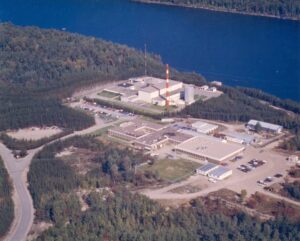
NPD site with reactor (near chimney) and training center