In mid-July 2026 the Canadian Nuclear Heritage Museum (CNHM) hosted two researchers from the Canadian Neutron Beam Laboratory (CNBL), which is situated at the McMaster Nuclear Reactor (MNR) in Hamilton, ON, and is currently Canada’s sole source of neutron beams. The visitors had been spending some time at the Chalk River Laboratories planning the move of the large L-3 neutron spectrometer from the NRU reactor to the MNR. The spectrometer was fabricated at Chalk River and was initially installed at NRU. It was a key instrument for many Canadian neutron-scattering researchers until the shutdown of the reactor in 2018.
Of concern to the visitors was difficulty locating detailed drawings of the spectrometer to facilitate the move. Fortunately, the CNHM was able to assist in this effort. The chief draftsman for almost all the neutron spectrometers developed at Chalk River by Nobel Laureate, Bert Brockhouse and his colleagues, including the L-3, was the late Bill McAlpin. In 2019, after Bill passed away, his family donated to the CNHM not only a number of Bill’s vintage drafting instruments but also two 1-m long mailing tubes. These mailing tubes contained not only a set of blueprints of the L-3 spectrometer, but also Bill’s original “pencil” drawings.
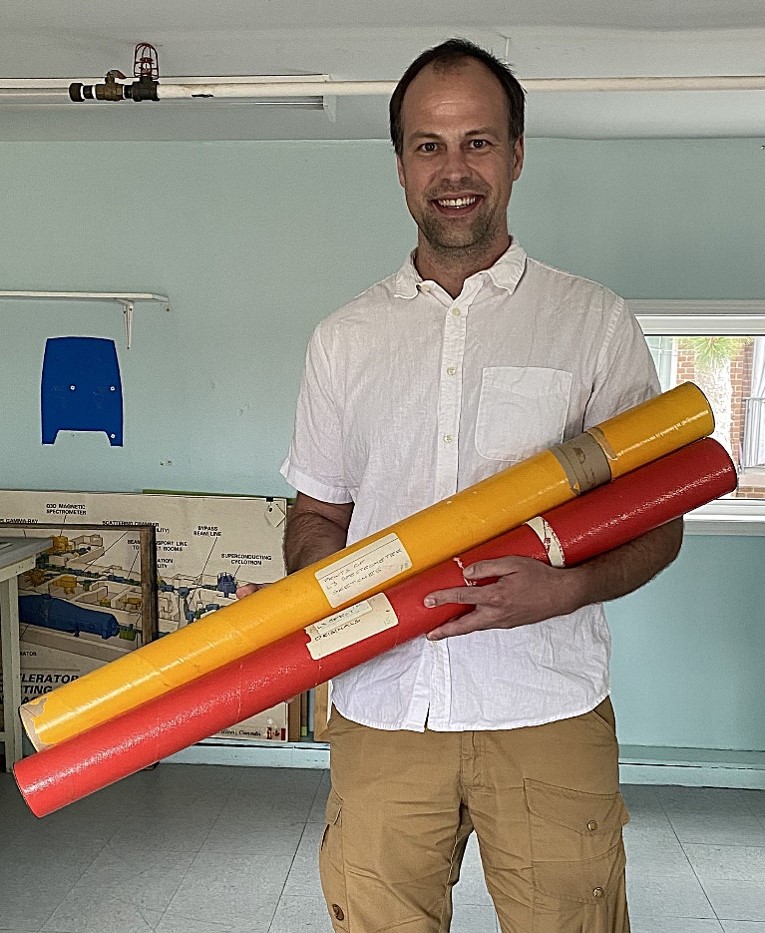
The 2026 Deep River Summerfest weekend saw the return to Deep River of one of the two earlier visitors, Eric Nicholson, who had worked at Chalk River from 2011 to 2016 and is now the Instrument Scientist at the CNBL. He returned to Deep River to enjoy the weekend activities and to pick up the McAlpin drawings which the CNHM has agreed to loan to McMaster. (Eric, I have been reliably informed, is the only person known to have unicycled from Deep River to the Laboratory).
In exchange for the loan, the CNHM has requested a “donation” of photographs and some artifacts related to the MNR – currently our collection consists solely of an MNR-themed T-shirt. The reactor has been in operation since 1959 and has served as a training ground and key research facility for many researchers and students over the years. Important connections between McMaster and Chalk River predate the reactor; the group lead by Harry Thode in the mid-1940’s did a great deal of groundbreaking work on accurately determining the masses of many fission products, particularly of the xenon isotopes. One of graduates from that group was the late R. (Bob) L. Graham who had a long and very productive nuclear spectroscopy career at Chalk River.
Anyone wishing to learn more about the L-3 spectrometer, its long history at Chalk River or about its future home at the MNR facility can arrange for a tour by contacting the CNHM at info.nuclearheritage.com .