
The start of the nuclear age brought with it the need for complex chemistry techniques and chemical apparatus to determine the properties of newly discovered elements and radioactive isotopes.
Many of the experiments on these materials required one-off apparatus, most often made of glass, that could not be easily purchased but instead had to be designed and fabricated at the laboratories.
A unique cadre of craftsmen/artists, labeled as “glassblowers”, was recruited and trained to meet the needs. The research labs of Atomic Energy of Canada Limited were fortunate to be able to successfully recruit experienced craftsmen from the United Kingdom, where glassblowing was a well-established trade.
In the case of the Chalk River laboratory, the individual hired was Rex Bailey. As work developed at the Whiteshell Laboratories, the laboratory was able to recruit another experienced glassblower, Jim Cafferty, and at the Radiochemical Company in Ottawa, the required skills were filled by Dennis Killick. All three of these gentlemen had apprenticed in the UK.
At Chalk River, Rex took on as an apprentice John Wesanko. After Rex’s retirement, Darcy Doering joined John as an apprentice. Merrill Gulick from the Detectors section of Chalk River was often called on to assist with complicated tasks. When John began his training in 1951, he was one of only 13 “scientific” glassblowers employed in Canada.
An excellent article on glassblowing in the April 1967 issue of AECL Review informs us that rather than glass simply being silicon-dioxide, eight different types are used in the trade, depending on the application. The types used are: quartz, Vycor, cobalt, lime, soda, potash, boron-free, and lead. Slightly different fabrication techniques are needed for each type of glass.
Not only were the materials different but so was the size of the apparatus required. Devices up to 2 meters in length were needed for experiments studying heavy water enrichment while, for experiments where only microgram quantities were available, tiny devices were required.
As off-the-shelf materials became more available, the role of glassblowers at research labs decreased but their skills played an important role in the nuclear industry.
At the Canadian Nuclear Heritage Museum, we are pleased to have a collection of the recreational aspects of Rex Bailey’s work. He used his skills to produce a collection of glass goblets he made as retirement or birthday etc. gifts. The artifacts were originally part of a collection made by Rex’s close friend, Colin Mawson. To see the goblet collection and hundreds of other equally interesting artifacts you can arrange a museum visit at info@nuclearheritage.com
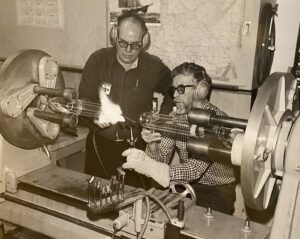
Merrill Gulick and John Wesanko work on a complex piece of glassware