
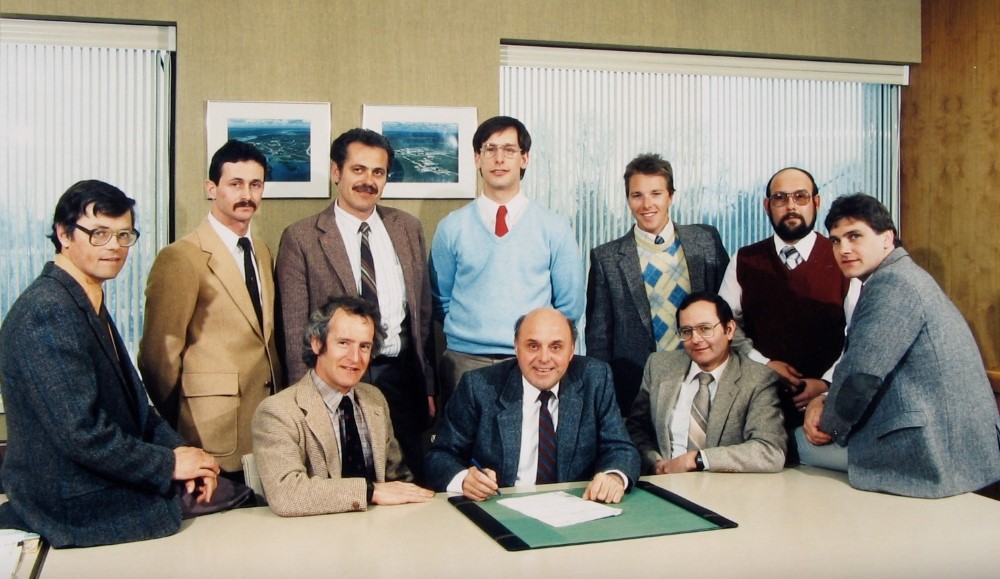
Signing of Contract for Space Shuttle O-Ring Work
Back –standing (L-R): Wade Mayo, Dino Spagnolo, Jeff Mackwood, Tony Spurgess, Richard Larose
In January 1986 the USA space program suffered a major set-back with the tragic explosion of the Challenger space shuttle during take-off. Subsequent examination of the recordings of the flight and of the rocket components determined that the cause of the explosion was the leakage of fluid through an O-ring sealed joint on one of the two space shuttle Solid Rocket Boosters (SRBs). The SRB was the most powerful solid rocket motor ever flown. The disaster caused a complete shutdown of the shuttle program and endangered the entire International Space Station (ISS) program, which was serviced by the shuttles. A major re-design of the shuttle booster rockets was launched immediately.
Jack Veeder of the Fuel Engineering Branch at CRNL was a man of many interests. In July when NASA released its report on the analysis of the booster rocket problems, Jack immediately recognized that there appeared to be an excellent fit of the shuttle “fluid” leakage problem with AECL’s expertise in “fluid seals” developed to retain CANDU’s most important fluid – heavy water. Jack wrote a memorandum to Norm Pothier, head of the Fuel Seal Technology Branch, highlighting the opportunity and the Commercial Office succeeded in convincing Morton Thiokol Inc. (MTI), the supplier of booster rockets to NASA, to visit Chalk River to assess AECL’s capabilities. The visit led to the awarding of several large commercial contracts to study various aspects of the critical O-ring joints.
Work by the AECL group, along with numerous other laboratories in the USA, led to a successful redesign of the joints and the restart of the shuttle program with the successful launch of the Discovery shuttle in October, 1988. This launch was closely monitored on a large screen at Chalk River by members of the group. This mission was followed by many more trouble-free launches, including two which transported Canadian astronaut, Julie Payette, now Governor General of Canada, to the ISS. The shuttle program was terminated in 2011.
The work performed by AECL was published in a joint AECL-TMI paper authored by Ron Wensel, Ray Metcalfe, Norm Pothier (all of AECL) and Brian Russell (TMI) in the Canadian Aeronautics and Space Journal. The paper was recognized as the best paper published in the journal in 1988 and the authors were honoured at a black-tie dinner in Ottawa.
Ron Wensel has continued to maintain social contact with his counterpart at TMI, Brain Russell, over the years and when the Society for the Preservation of Canada’s Nuclear Heritage Inc. (SPCNHI) sought to add a shuttle O-ring to its artifact collection, Ron put the Society in contact with Brian. Brian forwarded our request to Northrop Grumman, the lead agency for the shuttle program. Northrop Grumman have generously responded to our request and the Society now has in its artifact collection, a very large O-ring (11.9 m in circumference) as an example of the application of expertise developed for the nuclear industry to space research.
The Society would be very pleased to obtain artifacts or stories of other applications of nuclear expertise to non-nuclear science and industry. Contributions can be forwarded to info@nuclearheritage.ca or Box 441, Deep River, ON, K0J 1P0.