
I recently stumbled upon an article in the March 23, 1959, issue of the North Renfrew Times that piqued my interest; it was about the Chalk River-based work of entomologist Bill Baldwin.
Balwin’s work concerned the effects of radiation on the insect species Rhodnius, often called the “kissing bug” because of its tendency to collect the blood it needs for reproduction mainly from the lips of its victims. The 12-15 mm long insect, a resident of the forests of South America, is a carrier Chagas disease, a killer for young people that affects as many as one in eight people in Venezuela.
The insect was of particular interest to Balwin and his co-workers because it can survive radiation doses that are 200-300 times the doses that are fatal to humans. Part of this is due to the fact that the insect can delay division of its body cells by up to a year. It was hoped that understanding the mechanism of the process would further the understanding of radiation damage to human cells.
A decade later, the August 1969 issue of AECL Review reported Baldwin working with a close relative of Rhodnius, the species Traitoma. It also is a carrier of the deadly Chagas. The effort in this case was centered around finding the routes the insects use to enter the structures of typical Venezuelan huts and infect their victims.
To track movements of the insects, Bill and his colleagues injected small radioactive platinum wires into the abdomens of the insects and then traced their movements with simple Geiger counters. The Review article reported that work was also being done at CRNL on methods of attracting and destroying males of the insect species, to reduce the number of females who successfully mated and thereby improve population control.
Two years later, the April 1971 issue of AECL Review reported that Baldwin and his co-workers had switched tactics. Rather than destroying the males of the species they turned to the “sterile male” technique whereby males were sterilized by exposure to ionizing radiation and were released to mate with females; this resulted in a decrease in the number of fertile eggs laid. To work effectively, the sterile males had to be at least as sexually active as unirradiated ones. Baldwin and his group found that to maintain their survival rate and sexual aggressiveness, the insects had to be irradiated in a nitrogen atmosphere.
Unfortunately, Rhodnius females turn out to be rather promiscuous and mate with multiple males, only a few of which may be sterile; as of 2019, Wikipedia reports that 6.5 million people in Central and South America are still infected with Chagas resulting in an annual death rate of ~9500.
The Canadian Nuclear Heritage Museum has a large collection of reports and articles on the varied aspects of nuclear research and its applications. Visitors are invited to visit and learn about them. To arrange a visit contact us via info@nuclearheritage.com.
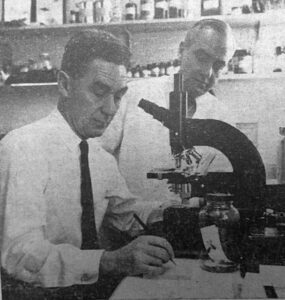
W.F. Baldwin and T.N. Salthouse examining Rhodnius (1959)