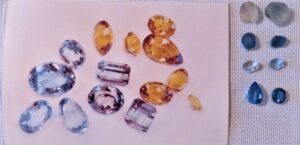
Two of the more popular gemstones, diamond and topaz, are usually colourless when found in nature, and various physical and chemical techniques have been used to increase their value by artificially introducing colour in them.
One of the most used techniques is irradiation. The earliest known attempt at this was performed in 1905 when English chemist William Crookes (developer of the Crookes tube, which led to the discovery of x-rays) buried a colorless diamond in powdered radium bromide for 16 months. The diamond became olive green.
The techniques most often used now are irradiation with neutrons or beams from particle accelerators. These methods depend on producing colour centers in the gemstone by displacing atoms from their positions in the gemstone crystal.
Neutrons, while being excellent at producing displacements and introducing a lovely “London blue” colour in topaz, are also extremely good at locating impurities in the gems and often making them radioactive.
Numerous powerful electron accelerators exist in laboratories or in industry and have been harnessed for the job, particularly in the case of topaz. At energies of 10 MeV or less, electron beams do not produce neutrons when they strike the gems and, after the treatment, no residual radioactivity is found. In addition, electrons penetrate deeper into the gems than do ions.
The first irradiations of gemstones at Chalk River were done in the NRX reactor, where several neutron irradiations were done on topaz. The amount of material irradiated was a few hundred grams and, as expected, some activation took place. This resulted in a significant time delay before the material could be returned to the customer for release to the public.
During the early 1990s, topaz dealers were not always well financed and, when billed by AECL for the NRX irradiations, were unable to pay. As a result, the gems remained in limbo at Chalk River for some time. The irradiation costs were recovered by selling the irradiated gems to Chalk River employees in a sale held in the Accelerator Physics conference room in Bldg. 145.
At that time the Accelerator Physics Branch was using its electron accelerators for commercial irradiations. It began with the 10 MeV, 3 kW, Pulsed High-Energy Linear Accelerator (PHELA). Irradiations of several kg batches of cut and polished topaz were performed for several gem dealers. (The dosage required is of the order 100 MGy (mega-Gray). As the market for irradiated topaz grew over the 1993-1996 period, the newly- commissioned Industrial Materials Pulsed Electron Linear Accelerator (IMPELA), which operated at an energy of 10 MeV and an average power of 50kW, began to be used for topaz irradiations as well. Over a period of one year more than1000 kg of market-ready, blue topaz (corresponding to 5 million carats) were irradiated.
Immediately after irradiation, topaz gems display a slight “smoky brown” tinge in addition to the desired blue colouration. The smoky effect is removed by baking the irradiated gems for several hours at 200 degrees Centigrade. The blue colour is quite stable but when the gems are mounted in a fitting, the colour centers may “heal” if the jeweler uses too high a temperature. The customer is then left with a colourless gemstone once more.
Visitors to the Canadian Nuclear Heritage Museum are invited to learn more about gemstone irradiation and to see samples of both topaz and beryl that were irradiated using electron beam irradiation. To visit, contact us at www.nuclearheritage.com