Strontium, when discussed in a nuclear context, generally has a negative connotation. The isotope Sr-90 was a major component of the fallout from nuclear weapons testing and was extensively studied for its deleterious health effects during the 1950s and 1960s, when it was found as a contaminant in milk and wheat. Sr-90 is known as a “bone seeker” and, with its long half-life of 29 years, is a long-lasting health hazard.
Sr-90 has found numerous uses as a tracer in many studies, but early work done by the Environmental Research Branch at Chalk River revealed that the non-radioactive (stable) form of strontium has equally valuable applications.
The April 1967 issue of AECL Review (Volume 2, Issue 4) reported an experiment led by Ivan Ophel and largely carried out by Jim Judd, which involved feeding small fish a diet rich in strontium for several weeks and following their growth over a number of years. The initial tests were done with the intention of using Sr-90 as the tracer.
However, it was found that only negligible amounts of Sr-90 were retained by the fish. The researchers then switched to the non-radioactive form and found that the amount of strontium retained by the fish increased significantly, and that the presence of strontium in a single fish scale could be detected and measured months after the special diet was stopped, without the need to kill the fish to test the bones. The strontium was detected using a flame photometer modified with the assistance of the Radiation Dosimetry Branch.
A significant portion of the strontium from the initial special diet was found to be bound in the scale structure and was believed to have biological half-life of years allowing long-time tracing of these “tagged” fish.
We have been unable to locate an AECL publication reporting the long-term results of these 1967 experiments. However, a Google search reveals the wide use in modern-day research of the measurement of the absolute concentration of strontium as well as the ratio of strontium to calcium in fish scales, to learn about the migration routes of different fish species and in locating their spawning grounds.
The Canadian Nuclear Heritage Museum library has a complete hard-copy and digital collection of the AECL Review that was first published in 1964 and over the years reported on many unusual aspects of research within AECL. To arrange a visit to scroll through these documents please contact us at info@nuclearheritage.com
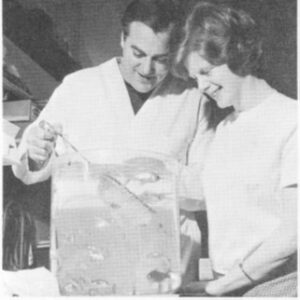
Jim Judd and Beryl Phillips examining some of the fish fed a strontium-rich diet
