This is the second of the extractions from the Gord Powell memoires “A Quarter Century among the Blackflies.” Powell was the Employment Office Supervisor at Chalk River Nuclear Laboratories from 1945 to 1969. Minor edits have been made.
“Back in1944 and1945, long trucks pulled into Deep River every day with sawed-in-two “Wartime” houses from Nobel and other closing Wartime plants. The houses were quickly re-assembled on temporary props. Talk about drafty. My first house was a Wartime four at 73 Algonquin. We had a crawling baby so during the first winter the draft was always open on the Quebec heater. Nevertheless, there was scarcely a day that you could not make snowballs from the frost you would gather off the baseboards.
You may not believe me, but on several occasions the milk froze in the living room and twice at least there was ice on the tea kettle in the morning while coals still lingered in the range. Mac Johnston performed an experiment one night and placed two thermometers – one on the floor and the other at the ceiling directly above. Guess the difference. I’m not going to put it in writing because no one in this world would ever believe me.
My daughter says I am sadly prone to exaggeration and if she ever reads this nonsense, she will not have the excuse of calling her old man, “liar”. Mine was one of the better Wartimers and I was one of the better firemen. When a kid at high school, it was always my lot to be the furnace tender, and all my life I have been accustomed to stoking. Many of the newcomers to our wilderness town were from the city, dwellers in heated apartments, and had no experience whatever with tending fires.
The only fuel we could buy was soft coal. Even respectable factories won’t use it now. Any kind of fuel was in short supply in those days and we had to haul it all the way from Pembroke. Talk about smoke and soot and filth. When you’d lift the lid from the Quebec heater, long six-to-seven-inch festoons of soot would dangle. It never happened to me, but I heard others tell tales of gas and smoke building up to the point that a small explosion blew open the front door. (I refer to the stove door: not even soft coal could open a house door.) At every social gathering, one of the chief topics of discussion was house heating. We were usually able, with the aid of a slight exaggeration, to turn a tragedy into a comedy.
I got billed for the same half ton of coal twice while Mac Johnston had half a ton delivered to him free. To this day, he does not know to whom he is indebted. One of the merchants in Pembroke had an old-fashioned spike filing system. He was always out of fuel and when he received an order, he placed it on tire spike on top of all the other orders already there. When he got a carload of coal, he took the top order off the spike and filled it first. I cannot swear to this, but Pembrokians state it is a fact and I don’t find any difficulty in giving it credence.
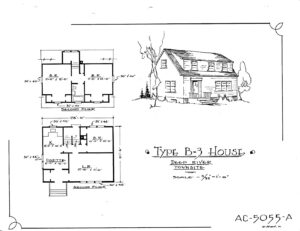
If the fuel was inferior, the houses were worse. I was always a severe critic of AECL’s house building programme. l used to implore Mr. Morison to let me hire an old farmer who was used to barn raisings and I would guarantee that some of the mistakes that were being made would be eliminated. But no. We went blissfully on our way. Even in the days when we were a Division of NRC and they had another Division of Building Research, little good it did us at Deep River. In my own house, for instance, a B 3, you could not get a continental bed upstairs. l bought a ping pong table for my rumpus room, but do you think I could get it into the basement? I did – by sawing a chunk out of the wall. And the outlets! They were all on a slant, but no two on the same slant. The first time I walked into the house, I was dizzy just from looking. And what a mess they made of the basement.
I happen to know who was responsible lor the B 3 design. but I am not mentioning names. The plan was lifted from Better Homes and Gardens, changed a little, and bingo, forty-four pieces of instant architecture were constructed.
The coal furnace was a monstrosity set on a cement pedestal plumb in the middle of the basement and from it radiated in all directions huge, round pipes. Even a dwarf had to duck to get under them. There was no space anywhere for a sports room, a workshop, or what have you. There was, of course, a huge coal bin in one corner. When Dr. Keys (God bless him) inspected the houses, he ordered that a small, fruit cupboard be built into the corner of each basement.
The firm that installed the heating (I believe it was either Cosmack or Cormack) apologized to me – that is, the Foreman did – for the terrible basement. He said words something like: “ &*@$ this darn basement spoils the whole house, but don t blame us. We pleaded with your Company to set the furnace back a few feet closer to the wall and put in higher, square pipes instead of these old-fashioned cylindrical things. That being the case, you would have had a basement that you could utilize, but some of your top brass have the old-fashioned idea that should have gone over the hill with the last horse and buggy, that a furnace must be under the exact centre of the house.”
But we should not kick. We soon tore out the old furnace and pipes, put a neat oil burner back against the wall, elevated and flattened the pipes, tore out the coal bin, and the B 3’s have a darn fine basement. When they gave us an option to buy, we had to pay $7250 for a house worth almost double that in the average city. Two, to my knowledge, sold recently, one for $17000 and one for $18000.”