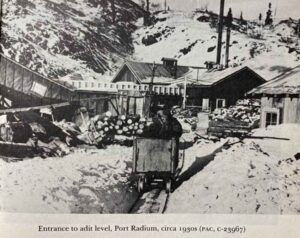
A previous article in this series (North Renfrew Times, March 14, 2025) discussed the entry of Canada into the radium market. This was made possible by the discovery of pitchblende in a rock outcropping on Great Bear Lake by Gilbert Labine in 1929. The resulting mine, usually called the Port Radium mine, was unique in a number of ways. Not only was it isolated in the North West Territories beyond any roads or rail lines, but it was on the edge of a very large lake.
Production from the mine began in 1931 with the ore concentrate being shipped to the Eldorado company refinery at Port Hope by barges up the Mackenzie River to a railhead at Waterways (now Fort McMurray) during the short summer, and by air to Edmonton during the winter months. The original aircraft used was the Eldorado Radium Silver Express. This Bellanca Aircruiser has been beautifully restored from wreckage and is located at the Royal Aviation Museum of Western Canada in Winnipeg.The permafrost at Great Bear Lake extends 320 feet below the surface; when the mining tunnel hit this level, at the end of one night shift, several feet of water were observed in one of the shafts. The lake was entering the mine visa cracks in the rocks. This unpleasant discovery hastily led to the installation of a large pumping system and the development of a grouting technique to stem the flow in the main cracks.
In 1940 after the start of WWII, the bottom dropped out of the radium market as countries conserved their funds for acquiring new armaments. This resulted in an Eldorado decision in June 1940 to shut down the mine at Port Radium and to greatly scale back activities at Port Hope. The war and the establishment of the Tube Alloys (UK) and Manhattan (USA) projects were to have an impact on Eldorado in short order.
The urgent need for uranium and the shroud of secrecy around its mining brought a change in Eldorado’s fortunes. By mid-1942 secrecy and the strategic needs for uranium led the Government of Canada, via C.D. Howe, to turn Eldorado into a Crown Corporation in 1944.
Although there was a stockpile of ore at Port Radium from before the 1940 shutdown, there was an urgent need to get the mine back in operation. The lake had succeeded in flooding most of the mine shafts during the shutdown, but the ice layer in the mine was only 15 feet thick and the damage was not too extensive.The mine, when back in operation, however, was beset with an increasing number of safety concerns. Of major concern was the buildup of radon gas in the mine and the dangers it presented to the workforce now that more was known about the gas. Ventilation had never been great at the mine and, in addition, ventilation ducts were sometimes stopped up to keep the frigid outside air from entering.
At the start of 1945 two scientists from the Montreal Lab were pressed into service to make the necessary radon measurements at this now high-security mine. The two scientists assigned to the task were Allan Nunn May and Bruno Pontecorvo! The reader may recall that Nunn May was later convicted by the British as a Soviet spy, and many questions exist as to the role Pontecorvo played in espionage. Significant improvements in mine ventilation did in fact take place over the next year; it operated successfully until 1960 when it ceased uranium mining operations because the ore ran out.Much of the detailed information in this column as well as in the previous column on radium has come from Robert Bothwell’s excellent book titled “Eldorado”.
Readers are welcome to visit the Canadian Nuclear Heritage Museum to further their own research on the Port Radium and Port Hope facilities, and to see claim tag 27218 from Port Radium. To visit contact info@nuclearheritage.com