
For more than four decades the National Research Experimental (NRX) and National Research Universal) (NRU) reactors at Chalk River were regarded as world-class research reactors. Their roles in reliably providing neutron beams to researchers, and critical medical and industrial isotopes to the world, have been well documented.
Much less publicised has been the role of the reactor loops in these two research reactors. What exactly is a reactor loop, you may ask?
The book Canada Enters the Nuclear Age (CETNA) defines a reactor loop as “a closed-circuit hydraulic system that provides a coolant and radiation environment similar to that in a nuclear power reactor”. The first reactor loop was installed in NRX in 1951 for an outside customer, Westinghouse Atomic Power Division (WAPD). It allowed testing of reactor fuel, under well-controlled conditions, for the United States Atomic Energy Commission and the US Navy submarine program.
Each loop, installed in a NRX or NRU fuel position, had its own pumps for circulation, heaters to maintain the desired temperature, and pressurizers to pressure the coolant to power reactor conditions. In addition, a separate data acquisition system was installed for each.
The first loop in NRX, installed in 1951 on behalf of WAPD, was followed by seven additional loops, labeled X-1 to X-7, over the years for tests on a wide variety of single-element fuels and for a wide range of customers.
NRU which allowed room for larger assemblies also played its role and over time four loops (U-1 to U-4) were developed and installed to allow testing of full-scale, power-reactor fuel assemblies which could be accommodated by its larger channels. The U-1 loop was later used to provide high-pressure high-temperature water for the in-reactor Blowdown test series in the 1990s, which simulated postulated accident conditions and the effects upon reactor fuel.
The experimental loops at Chalk River were crucial for providing the experimental data needed to design and build the fuel bundles needed for the highly-successful CANDU power reactors. They were also a source of income for AECL in servicing a large range of outside customers. The demands for continuous operating time on the loops, together with the continuing need to produce medical isotopes, made scheduling operation at the research reactors a trying task.
Each loop had a unique assembly similar to a small pipe organ associated with it. Should some loop parameter, such as temperature or pressure, stray outside pre-set values, an air blast would be sent through the whistle to warn experimenters.
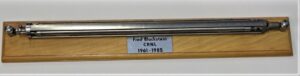
Since the loops often became contaminated to some degree with radioactive material, very little could be retained for posterity when they were disassembled at end-of-life. However, the Canadian Nuclear Heritage Museum (CNHM) has two items from them. One of them is a spare, trefoil fuel carriage from an NRX loop given to Fred Blackstein as a retirement gift. The second is one of the NRX loop whistles.
Visitors are always welcome to the CNHM to see the above artifacts and the more than 650 other ones housed there. Unfortunately, the volume of air required to test the whistle for sound exceeds what even the best “blow-hard” is likely to achieve.

Loop whistle
Single element carrier for loop