Nuclear fusion as an energy source is in the news a lot these days, reminding me of another period of excitement a few decades ago. Early in 1989, the world heard the stunning announcement that a pair of chemists in the US had demonstrated desktop nuclear fusion. All it took was an electrolysis cell filled with heavy water and palladium electrodes. The “cold fusion” saga made headlines worldwide, and of course dominated coffee and lunchtime conversations at AECL’s research labs. AECL had the world’s largest supply of heavy water, thanks to the CANDU reactor design. So why not try to duplicate the results? If we succeeded, AECL could provide the world with unlimited energy! At the Whiteshell Nuclear Research Establishment in Manitoba, where I worked at the time, talk quickly turned to action. Within a day or two, a pair of our brightest boffins (British scientists), Keith Chambers and Roger Dutton, had put together a team and ordered materials. Since the fusion reactions were supposed to produce some neutrons, some gamma rays, and some tritium as well as heat, I got involved on the measurement side. Many other groups, at Chalk River and around the world, were also trying to duplicate the extraordinary claims. The race was on!
Keith and Roger did a fine job of promotion, both within AECL and beyond. We highlighted the team’s combination of theoretical expertise and skill in experimentation. We did a few radio interviews—mine was on Radio-Canada in French! Management provided funding, and eventually Manitoba Hydro also became a patron of our work. The Deep River Science Academy (Whiteshell Campus) sponsored student projects for a couple of summers. I monitored the cold-fusion “listserv” (text-based online discussion group) for the latest theories and results from other labs.
To catch any neutrons being produced, we cannibalized one of our old neutron counters and set it up around our custom-built electrolysis cell. We attached data recorders, both analog and digital. And then we waited. Some peculiar signals turned out to be electronic “noise” from other equipment in the room. We worked on reducing possible sources of interference, and tried to increase our sensitivity. And then we waited some more. After a while, we had observed a few more anomalous results, which we couldn’t explain as noise. On more than one occasion, neutron counts rose sharply, then gradually declined back to background levels. What was going on?
It turned out that two of these anomalies had occurred while electrical power to the electrolysis cell was off. Clearly this wasn’t cold fusion taking place, but the signals indicated there were actual neutrons being detected. I consulted with some solar physicists at the National Research Council, who checked their records. It turned out that that there was a more distant source of neutrons: “hot” nuclear fusion from the sun! Solar flares had sent charged particles into the Earth’s atmosphere, resulting in a shower of neutrons at ground level. We quickly wrote up these results as a note to the science periodical Nature, and had our brief moment of fame. But we never detected any more neutrons, or any other signs of “cold fusion,” even after operating our apparatus for over a year longer. Our experiments eventually ended, as did most of the others around the world, and the cold fusion idea faded away, except for some die-hard “believers” who persist to this day.
Morgan Brown, president of the Society for the Preservation of Canada’s Nuclear Heritage, adds:
Many thanks to Mike Attas, a fellow member of SPCNHI, for his cold fusion story. In our Canadian Nuclear Heritage Museum library we have a copy of Atomic Adventures by James Mahaffey, who includes a detailed but readable account of his involvement in cold fusion at the Georgia Tech Research Institute. Essentially the GTRI group tried to emulate the work announced by Pons and Fleischmann; GTRI succeeded, and gave a press conference on 1989 April 10 to describe the apparent confirmation. Then, to their horror, the GTRI group discovered their neutron counter was faulty (or at least their understanding of its operation at very low count rates), leading to a retraction of their first press release on April 13. Aside from the embarrassment, the researchers then suffered harassment from conspiracy adherents who believed the GTRI team had been bought off or threatened with death! Cave publicum!
At the SPCNHI we welcome (true!) stories of nuclear science and technology, including the weird and whacky. Come visit our museum to hear a few tales of the unexpected.
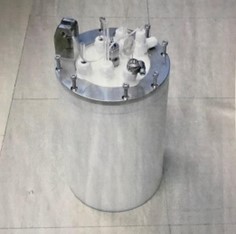
The cold-fusion electrolysis cell (~30 cm tall) built by machinists at AECL’s Whiteshell Nuclear Research Establishment (WNRE) to the design sketches of Keith Chambers and Roger Dutton. It was never commissioned because Manitoba Hydro ceased funding the cold fusion program.
