One of the things people visiting the Canadian Nuclear Heritage Museum (CNHM) most appear to enjoy is the opportunity to hold in their hands a CANDU reactor fuel bundle. While the bundle they handle at the Museum is a mechanically-accurate replica of an actual bundle and is the correct length (50 cm), the weight of it (5 kg) is only about 25% of the weight of an actual, uranium-loaded, bundle.
The concept of the fuel bundles used in CANDU reactors started in the late 1950s when the second (horizontal tubes) version of the Nuclear Power Demonstration (NPD) reactor at Rolphton was being designed. It was envisaged that a series of bundles would be used in each horizontal pressure tube and that bundles could then be replaced while the reactor was at full power on-line – a unique reactor concept.
The fuel channel length at NPD was originally designed to be 4 m in length and it was proposed to use 8 bundles per channel, giving a length per bundle of 50 cm. (Actually 19.685 inches, then rounded to 19.5 inches in the pre-metric era). Later refinements in the NPD fuel channel design led to the use of 9 bundles per channel but the length of 50 cm has persisted to today, in spite of many other design changes.
Each fuel bundle consists of a number of fuel elements. The elements, which vary in number in different fuel designs from 7 to 43, use thin-walled (typically 0.4 mm) zirconium or zirconium alloy tubing and contain ceramic-like, uranium oxide pellets. The cylindrical pellets, typically 10 mm in diameter and 13 mm in length, weigh 10-20 g each.
Other than NPD, which used both 7 and 19 element bundles, typical CANDU reactors use identical bundles throughout the core.
A large reactor such as one of the units at the Darlington Nuclear Generation Station, which has 480 channels each holding 13 bundles, contains 6240 bundles.
Each fuel bundle, which typically resides in a reactor for 12-20 months, releases enough energy during its lifetime to power an average Canadian home with electricity for 100 years.
After their useful life in a reactor, the “spent” fuel bundles are removed and kept in water-filled pools for a period of 7-10 years. When the residual decay heat (and radiation) has subsided, the bundles are then stored in specially-constructed, above-ground dry containers until final placement in a dedicated permanent facility located deep underground. A facility of this type is scheduled to be built near Atikokan in north-western Ontario. The total number of bundles now awaiting final storage in Canada is 3.3 million.
Those of you wishing to learn more about CANDU fuel bundles are invited to book a tour of the CNHM at info@nuclearheritage.com. Should you want to do some “homework” to prepare for your visit, there is an excellent YouTube video on CANDU fuel bundles narrated by Osama Baig at https://youtu.be/8qHRZbX3Kf0?feature=shared
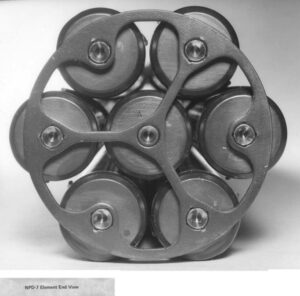
Seven element fuel bundle for NPD reactor
