
The Canadian Nuclear Heritage Museum recently received a copy of the unpublished memoir of Gordon Powell, Employment Office Supervisor at Chalk River from 1945 to 1969. In his introduction he states “This work has little literary value and not much historic. I have thrown it together solely to keep evergreen my own memories of a happy past. But if some old-timers at Chalk River should get a chuckle out of reading it so much the better.”
We have extracted, with minor edits, the following from the start of his memoire:
“I am not positive but, perhaps, I have site seniority over every other employee at Chalk River. In September 1944, Defence Industries Limited, for whom I worked at Nobel [just north of Parry Sound], consented to lend my services to Fraser Brace, who had been commissioned to build a large and mysterious plant at Chalk River. My duty was to establish an employment system. I lived at the Copeland Hotel in Pembroke and bounced back and forth, morning and night, with Jeff Palmer, the engineer who built this Plant, and with Charlie Gray, his assistant. I’ll never forget the first trip I made from the highway into the Plant site. If you were a good driver and ducked at the right time so you wouldn’t lose an eye by getting swiped in the face by overhanging foliage you still stood an excellent chance of bogging down in the sand.
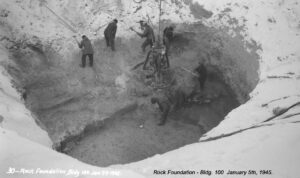
On the Plant site itself, stood not a single building. NRX was a hole in the ground, a hole so deep we gaped into it and wondered if they were reaching for China. A Quonset hut was being raised so there would be a sheltered spot for material that was starting to drift in, and the first of the old Fraser Brace camps down the river shore was half constructed. The thirty-two hourly paid slaves, the first of many hundreds to follow, bunked down in Bell tents [single vertical central pole], courtesy of the Petawawa Camp, while the half dozen staff men were living in luxury at Moore’s cabins, north of what is now Deep River.
When I returned to Nobel, I thought I had brushed forever the Jackpine needles of Chalk River from my coat, but just a year later –almost to the day – Ian Ritchie approached me at Nobel, which by this time, was in its death throes, and asked me if I would come to Chalk River to head employment for Defence Industries Limited. I was, at the time, considering an offer from the Wartime Prices and Trade Board in Toronto. There’s one thing that I really love about Toronto – leaving it. So, it wasn’t hard to accept Mr. Ritchie’s offer. Thus, in mid-September 1945, I found myself again beside the lovely Ottawa, this time ensconced for a tenure of twenty-three years to feed the Blackflies.
I’ll never forget those early days. It was work, work, work. Hectic, but we did have fun. Few of us had our wives with us and DIL bunked us in sparsely furnished wartime houses. I arrived in the middle of the night, and Jack MacKinnon took me upstairs in the wartime six at the corner of Pine Street and Deep River Road that has long since been demolished to make way for a shopping plaza. There were two beds and Eric West was snoring musically in one. Jack woke him up and that was my introduction to a chap with whom I’ve enjoyed working for a long, long time,
At one time there were thirteen of us in that old house on Pine Street. Among them were Percy Adams, who was tragically drowned when crossing the Ottawa River behind the Staff Hotel, Roger Johnson, Pete McConnachie, Al Colp, and some Fraser Brace French-Canadians. The French-Canadians slept downstairs and loved a big hot fire in the Quebec heater. There was no door or any method of trapping the heat downstairs, so it exploded in a steady stream to the two upstairs bedrooms. Eric and I, many a night, sweltered in our beds.
We, wifeless willies, who slept in Wartime houses, ate with a thousand construction workers in the cafeteria. I’ll never forget the meals we used to get at Crawley’s. I don’t think they were really bad, but I am not the best judge, since my wife tells me I have a cast iron stomach. Anyway, they were meals prepared for big husky outdoor construction men – not for white collar pansies. Poor Eric – day after day -blood pudding was on the menu. In spite of a bountiful table, Eric often left the cafeteria as hungry as he entered.
Wash day was a big day, it was always on Sunday. We were on an expense account and were allowed so much for each piece of laundry. I’ll swear some of the boys laundered socks three times between wearings and we hung them on improvised line after line all through the house. The aroma resembled a rose arbour in June. Trying to duck between the drying clothes to get from one room to another was just about as easy as piercing the Maginot Line.
There were no Researchers in those days, no Operations people, and no Administration. We were all Company. Everybody was everybody’s friend in the pioneer days. It is an accomplishment to establish order out of chaos: but, oh boy, you lose more than disorder when the chaos is destroyed.”
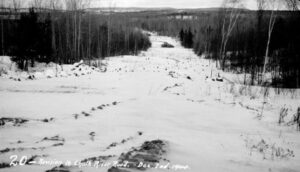
Improved Plant road December 1944